
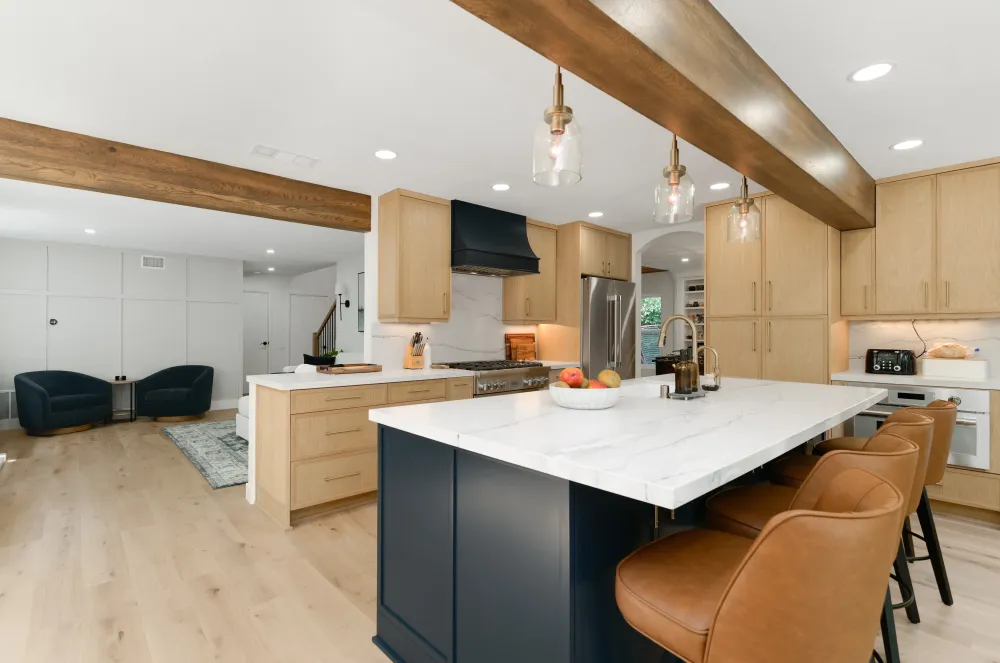
Cabinets occupy more visual space than anything else in a kitchen and take more daily handling than any other surface. Here is what separates the options.
Door style sets the tone
Almost everything else follows from the door. A few of the common ones:
- Shaker. A flat recessed panel in a square frame. It has stayed popular for decades because it reads as neither strictly traditional nor strictly modern, and it sits comfortably in most homes.
- Flat slab. A single unbroken face, no frame. Clean and contemporary, and the easiest style to wipe down since there is no profile to catch anything.
- Raised panel. A center panel that projects forward within the frame. Traditional, with more shadow and depth.
- Beadboard and inset detail. Vertical grooving or a door set flush within its frame. Both lean cottage or classic, and inset construction in particular is precise work.
Framed versus frameless
A framed cabinet has a face frame across the front of the box, with doors mounted to it. A frameless cabinet omits the frame, and doors mount directly to the box.
Frameless gives you slightly wider openings and drawers, and a tighter, more continuous look across a run. Framed construction is the more traditional approach and pairs naturally with inset doors. Both are sound; they simply lead to different proportions.
What the boxes are made of
The door gets the attention, but the box carries the weight — literally, in the case of a run holding dishes.
- Plywood boxes hold fasteners well and tolerate moisture better than particleboard, which matters under a sink.
- Solid wood doors and frames move slightly with humidity. This is normal, and it is why panels are built to float rather than being glued rigid.
- MDF is very stable and takes paint beautifully, with no grain telegraphing through and no joints to open up over time.
A common approach is MDF for painted doors and solid wood where the grain is meant to show.
Painted, stained, or something else
Paint gives you an even, uniform color and hides the grain. It also shows wear at the points where hands land — around knobs, along the edge nearest the dishwasher — more visibly than stain does, though it can be touched up.
Stain lets the grain through and disguises minor marks better, but the wood species drives the result. The same stain on oak and on maple produces quite different outcomes, because the grain absorbs it differently.
Thermofoil and laminate wrap the door in an applied surface. They are consistent and easy to clean, and they cannot be refinished later the way wood can.
On two-tone kitchens
Pairing one color on the perimeter with another on the island has stayed popular for good reason — it breaks up a large expanse of cabinetry and lets the island read as furniture. If you go this route, it helps to keep the door style consistent across both so the difference reads as intentional.
Storage that earns its space
The interior fittings often make more daily difference than the door style:
- Deep drawers instead of low cabinets for pots, so you are not reaching into the dark
- Full-extension slides, so the back of the drawer is genuinely reachable
- Corner solutions rather than a dead cavity
- A narrow pull-out beside the range for oils and utensils
- Drawer dividers specified up front rather than added later
Hardware
Knobs and pulls are the easiest element to change later, and the part you touch most. It is worth handling samples before committing — the weight and the finish read very differently in your hand than in a photograph.
Soft-close hinges and slides have become standard on most quality cabinetry, and they are one of those details you stop noticing precisely because they work.
Worth remembering: cabinet decisions are among the hardest to reverse later, since everything else in the kitchen is fitted around them. It is the place to slow down.