
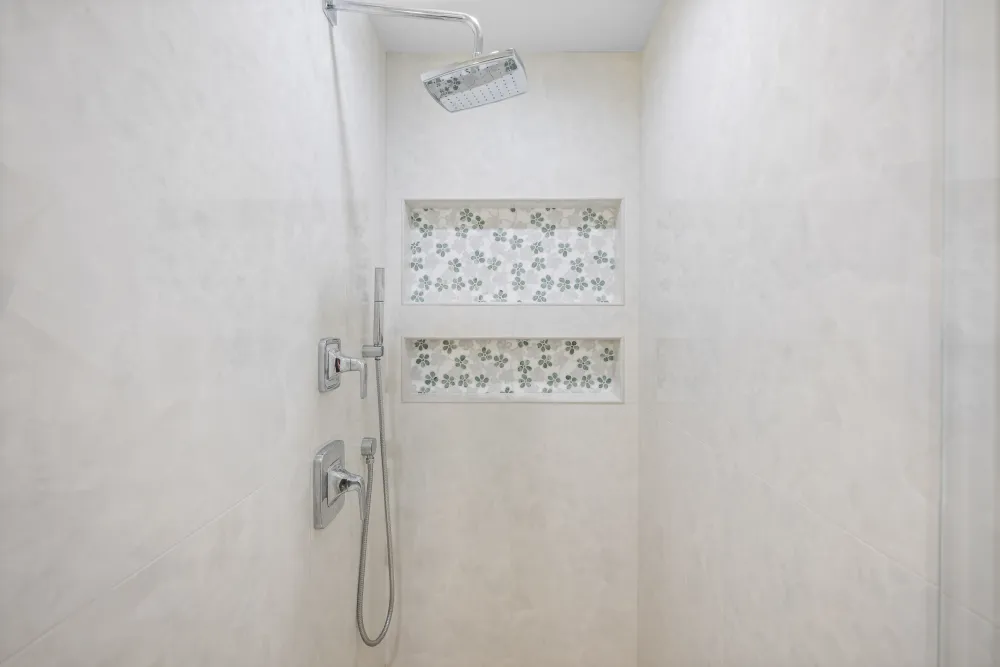
Tile does more work in a bathroom than anywhere else in the house. It has to look right, survive constant water, and stay safe underfoot.
Porcelain and ceramic
Both are fired clay; porcelain is fired denser and absorbs less water, which is why it is the usual choice for floors and wet areas. Ceramic is lighter and easier to cut, and it is common on walls.
Through-body porcelain carries its color all the way through, so a chip is far less visible than on a glazed tile with a different-colored body underneath. On a floor that will take dropped objects, that matters.
Natural stone
Marble, travertine, slate and limestone each bring something manufactured tile cannot quite reproduce. They are also porous and need sealing, and that sealing is repeated over time.
In a shower, stone requires more ongoing attention than porcelain. Some homeowners are glad to give it; others find it wearing. It is worth being honest with yourself about which you are before choosing it for the wettest room in the house.
Glass tile
Usually seen in accents, niches and backsplashes. It is non-porous and reflects light, which lifts a dim corner.
Because it is translucent, the setting material behind it affects the final appearance, and it needs a careful hand to install well. It is generally used as a feature rather than across a whole room.
Floors: texture matters more than pattern
A bathroom floor gets wet. Polished tile becomes slick when it does.
Tiles carry a slip-resistance rating, and it is worth asking about it rather than choosing on appearance alone. Smaller tiles put more grout lines across the floor, and grout adds grip — one reason mosaic remains a common choice for shower floors, along with its ability to follow the slope toward the drain.
Size and proportion
Large-format tile means fewer grout lines and a calmer, more continuous surface. It also demands a flatter substrate — a big rigid tile cannot follow an uneven wall, and any deviation shows at the edges.
Smaller tile is more forgiving of imperfect surfaces and curves, follows a sloped shower floor properly, and gives more grip. The tradeoff is more grout to clean.
Layout patterns
- Stacked. Grid-aligned, quiet and contemporary. Unforgiving of any wall that is not straight, because the eye follows the continuous lines.
- Offset or running bond. Each row shifted from the last. More traditional, and more forgiving of slight variation.
- Herringbone and chevron. Visually active. Generates more cuts and more waste, and rewards careful setting out.
- Vertical stack. Draws the eye upward, which suits a room with limited floor area.
Grout
Grout is not an afterthought — it is a substantial part of what you see.
Matching grout to the tile makes the surface read as one continuous plane. Contrasting grout emphasizes the pattern and the shape of each tile. Neither is wrong, but they produce very different rooms from identical tile.
Lighter grout on a floor shows traffic more readily than a mid-tone. Modern grout formulations vary considerably in how they resist staining, and it is worth asking what is being used and what it will need over time.
What sits behind the tile
In a shower, the assembly behind the tile does the actual work of keeping water out of the structure. Tile and grout are not themselves waterproof — water passes through grout.
This is the part nobody sees and the part most worth getting right, because it is the layer that protects everything behind it. If you are comparing approaches, it is a fair thing to ask about directly.
Ordering tip: order extra beyond the measured area. Cuts, breakage and pattern alignment all consume material, and dye lots vary between production runs — matching a batch later is often not possible.