
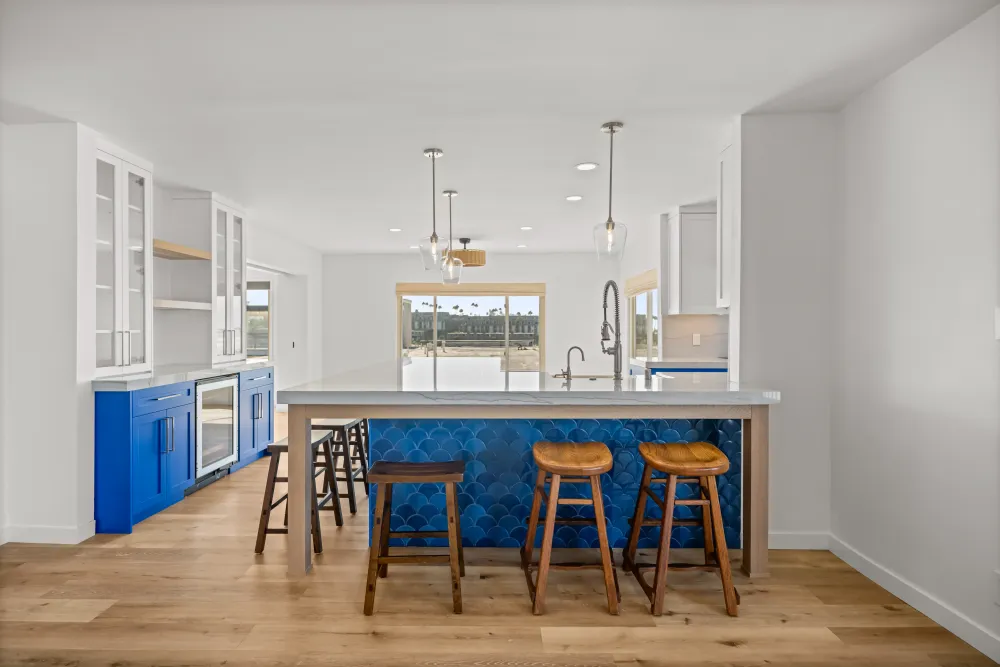
Countertops take more abuse than any other surface in the house. The right choice depends less on how it looks in the showroom than on how you cook.
Engineered quartz
Ground natural quartz bound with resin and pigment. Because it is manufactured, the pattern is consistent from slab to slab, and the surface is non-porous — it does not need sealing and does not absorb spills.
The resin is the thing to know about. It is what makes quartz stain-resistant, and it is also why quartz is sensitive to heat. A pan straight off the burner can mark it. Trivets are not optional here.
Granite
Quarried stone, cut into slabs. Every slab is unique, which is either the appeal or the complication depending on your temperament — it is worth seeing the actual slab rather than a sample chip.
Granite handles heat well. It is porous to varying degrees depending on the stone, so it is sealed, and the sealing is repeated periodically. How often depends on the particular stone and how hard the surface is used.
Marble
Beautiful and softer than granite. It etches when it meets anything acidic — lemon, wine, vinegar — which leaves a dulled mark in the polished surface. It also scratches more readily.
People who love marble tend to accept that it will develop a patina, and many prefer it that way. People who want a surface to stay exactly as installed usually find it frustrating. Knowing which camp you are in beforehand saves a lot of regret.
Butcher block and solid wood
Warm underhand and repairable in a way stone is not — sand out a scar and refinish. It needs oiling to stay conditioned, and it does not love standing water, so the run beside the sink deserves some thought.
A common approach is wood on an island where people gather, paired with a harder surface around the sink and range.
Solid surface
An acrylic-based material, non-porous, with seams that can be joined nearly invisibly and integrated sinks that eliminate the rim entirely. Scratches and minor damage can generally be sanded out.
It is softer than stone and sensitive to heat, so it wants the same trivet discipline as quartz.
Tile
Less common on counters than it once was, but it handles heat well and a damaged tile can be replaced individually. The grout lines are the consideration — they need sealing and they collect what gets spilled on them. Larger tiles with tighter joints reduce that.
Matching the surface to how you cook
Rather than ranking materials, it helps to match them to habits:
- Pans come off the heat and go straight down. Granite handles this best; quartz and solid surface do not.
- You want it to look the same in ten years. Quartz is the most predictable. Marble is the least.
- You would rather not maintain anything. Quartz and solid surface need no sealing.
- You want every slab to be one of a kind. Natural stone, and go see the slab in person.
- Kids, homework, projects, general chaos. Durability and repairability matter more than the finish. Wood and solid surface can be refinished.
Edges and thickness
Edge profile and slab thickness change the character of a kitchen more than people expect. A thin squared edge reads modern; a thicker profile reads substantial and traditional. Mitered edges can build apparent thickness without the weight of a solid slab.
Look at samples on a horizontal surface at counter height rather than held up vertically. It is a different impression entirely.
One practical tip: bring a sample home and live with it for a few days before deciding. Kitchen lighting, your cabinet color and the daylight in your room will change how a surface reads far more than showroom lighting suggests.