
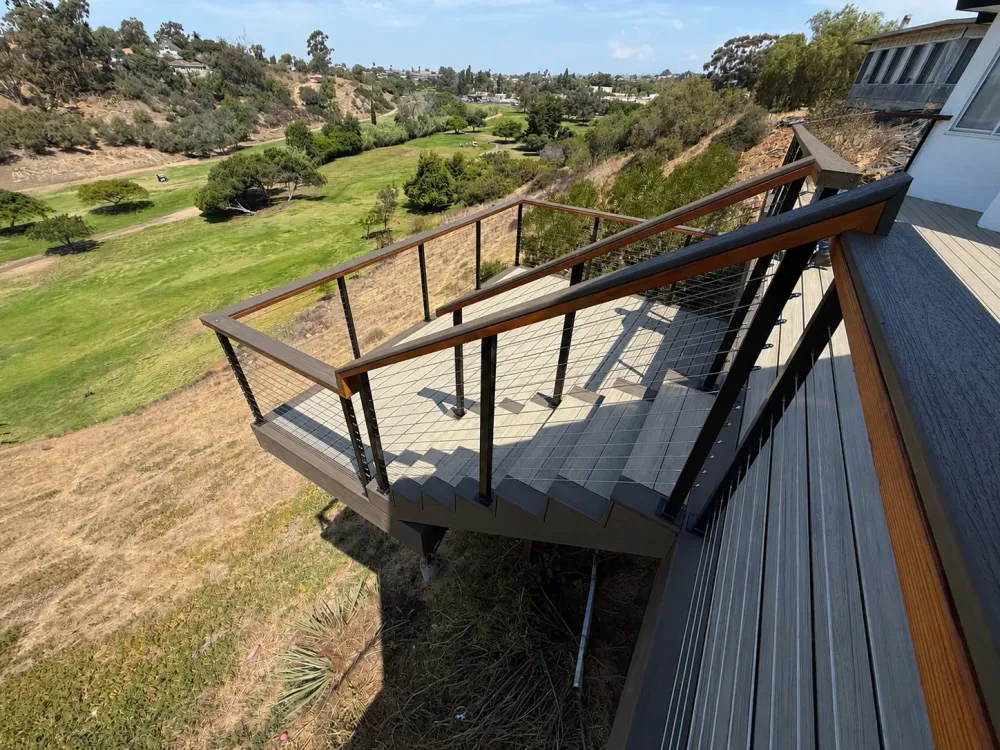
Decking splits into two families — boards that are wood and boards that are engineered to look like it. The right answer depends less on which is better than on how much maintenance you actually intend to do.
The engineered boards
Composite
Wood fibre combined with plastic and formed into boards. It does not splinter, does not need refinishing, and does not rot the way timber can.
The distinction that matters most within composite is capped versus uncapped. A capped board carries a protective polymer shell over its core, which resists staining and fading considerably better than an exposed composite surface. Most current products from the major manufacturers are capped, and it is worth confirming rather than assuming.
Trex is the name most people know, and its current lines are capped composite. TimberTech offers capped composite as well, and its boards are among the more convincing at reproducing timber grain — the better lines vary the pattern from board to board rather than repeating one embossed texture, which is what usually gives engineered decking away.
PVC
All plastic, with no wood content at all. Because there is no organic material in the board, there is nothing for moisture or insects to act on.
PVC is lighter than composite and generally the most resistant to staining and fading. TimberTech's AZEK range is the best-known example. The tradeoff is that some people find it reads as slightly more synthetic underfoot and in appearance, though the higher lines have narrowed that gap considerably.
Heat, which matters here
Any engineered board absorbs more heat than timber, and colour drives it more than material does — a dark board in full San Diego afternoon sun gets genuinely hot underfoot.
Some manufacturers now make lines specifically formulated to run cooler. If the deck is in full sun and people will be barefoot on it, this is worth asking about directly, and it is a strong argument for choosing a lighter colour than the sample board makes you want.
The timber options
Redwood
The traditional Southern California decking timber, and still hard to beat on appearance. The heartwood is naturally resistant to decay and insects, and it takes stain well.
Left alone it weathers to a soft silver-grey. Kept its original colour, it needs periodic cleaning and refinishing, and how often depends almost entirely on sun exposure. A south or west-facing deck will ask for it more frequently than a shaded one.
One thing worth knowing: the natural resistance is in the heartwood, not the sapwood, so grade matters.
Cedar
Similar in character to redwood — naturally decay-resistant heartwood, aromatic, weathers to grey if left unfinished. Slightly softer than redwood, so it marks a little more readily underfoot.
Tropical hardwoods
Ipe and similar species are extremely dense and extremely durable. They are also heavy, hard on tools, and usually need pre-drilling, which makes installation more involved.
They take oil to hold their deep brown tone, and without it they weather to grey like any timber. For a deck meant to last decades with a genuinely high-end look, they are a serious option — provided you are willing to oil them.
Choosing between them honestly
The decision usually comes down to one question asked truthfully: how much maintenance will you actually do?
- None, realistically. Capped composite or PVC. This is the honest answer for most households and there is no shame in it.
- Cleaning and refinishing every year or two. Redwood or cedar, and you get a material engineered boards still cannot quite replicate.
- Oiling regularly because you enjoy it. Tropical hardwood.
- Barefoot use in full sun. Lighter colours, and ask about cool-surface lines.
- Near the coast. Everything is harder here. Engineered boards handle salt air well; timber needs more attention; and the hardware matters as much as the boards.
Details beyond the board
A few specifications affect the finished deck as much as the material:
- Hidden fasteners give a clean surface with no screw heads. Most engineered systems support them; they need to be planned for.
- Joist spacing is set by the board manufacturer, and patterns like diagonal or herringbone require tighter spacing. This is a framing decision, so the board has to be chosen before the frame is built.
- Fascia and trim in matching material is what makes the edges look finished rather than exposed.
- Expansion gaps matter more with engineered boards, which move with temperature more than timber does.
- Substructure is timber in most cases regardless of the deck surface, and it is what determines the deck's life.
Before choosing on a showroom sample: get full-length boards if you can, put them outside, and look at them in direct sun and in shade. Colour and grain read very differently on a small sample under indoor lighting than on a full deck outdoors — and leave a dark sample in the sun and feel it after an hour.