
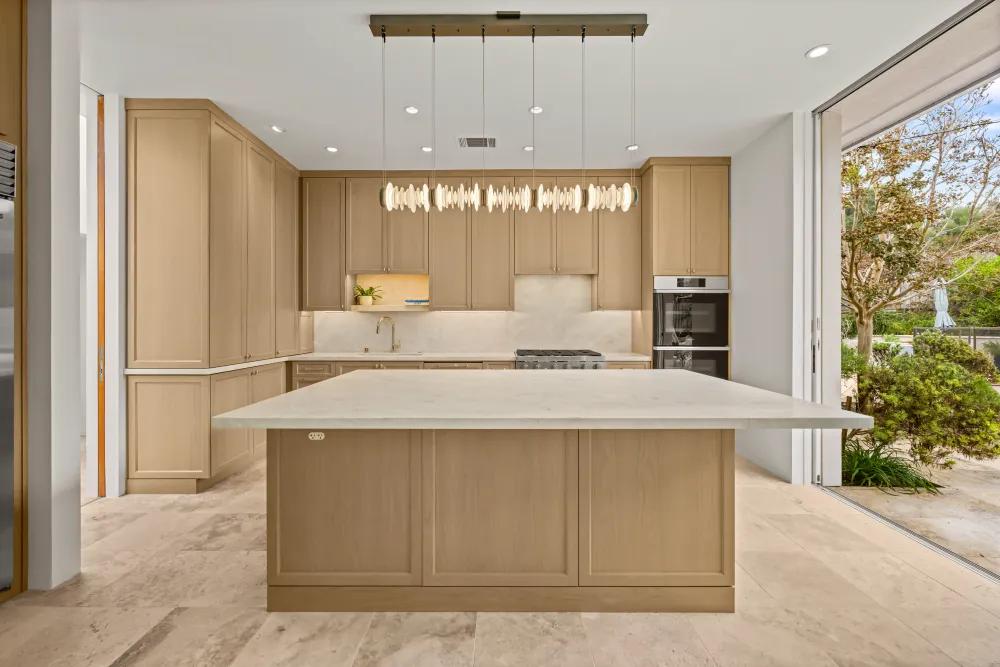
Lighting is the element most often left until the end of a kitchen project, and the one most likely to undo good work. A beautifully built kitchen lit by a single fixture in the middle of the ceiling will never look like the photographs.
Why one fixture is not enough
A single light in the center of the ceiling puts the source behind you at every counter you stand at. Your own body blocks it, and you end up chopping in your own shadow.
It also flattens the room. One source from one direction gives you a uniform wash with no depth, which is why kitchens lit this way look serviceable but never inviting. The fix is not a brighter bulb — it is more than one kind of light.
The three layers
Task lighting
Light aimed at the surfaces where you actually work. Under-cabinet lighting is the workhorse here: mounted beneath the wall cabinets, it lights the counter from the front, so nothing you do casts a shadow onto your own work.
Position matters more than output. Fixtures set toward the front edge of the cabinet underside throw light across the whole counter depth. Pushed to the back, they light the backsplash and leave the front edge dim.
The sink and the range need their own attention, since neither usually sits under a wall cabinet. A recessed fixture directly above each covers it.
Ambient lighting
The general fill that keeps the room from reading as a series of bright pools in a dark space. Recessed ceiling fixtures spread across the room are the common approach.
The usual error is spacing them evenly across the ceiling as a grid without regard to what is below. Better to place them relative to the work areas and walkways — over the front edge of the counters rather than centered over the cabinets, where much of the output lands on cabinet tops.
Accent and decorative lighting
Pendants over an island, a fixture over the table, lighting inside glass-front cabinets, or a strip washing a shelf. This layer does the least practical work and the most for how the room feels.
Pendants are the most visible decision in the kitchen after the cabinets. Hung too low they block sightlines across the island; too high they stop reading as part of the composition. It is worth mocking up the height with a temporary hanging piece before the electrical is set.
Color temperature and consistency
Warmer light reads cozy and traditional; cooler light reads crisp and contemporary. Neither is wrong, but mixing them within one room is.
The most common lighting mistake in a finished kitchen is not brightness — it is under-cabinet fixtures at one temperature and ceiling fixtures at another. The eye picks it up immediately even when people cannot name what is bothering them. Specify one temperature across every fixture in the room.
Also worth asking about is color rendering, which describes how faithfully a light source shows color. It is the difference between food and finishes looking accurate or looking slightly off.
Dimming
A kitchen at 7am and a kitchen at 9pm want very different light. Dimmers on the ambient and accent layers let one room do both.
Put the layers on separate switches so they can be used independently. Being able to run only the under-cabinet lights in the evening turns the kitchen into a completely different room.
Practical points worth deciding early
- Which layers go on which switch, and where those switches live relative to the doors you enter from
- Whether the dimmers and bulbs are compatible — mismatches cause flicker and buzz
- Where under-cabinet power is run, which has to happen before the cabinets go in
- Pendant positions, which need to be set before the ceiling is closed up
- Whether any cabinet interiors are getting lit, since that wiring runs inside the boxes
The scheduling reality: lighting decisions have to be made far earlier than they feel like they should, because the wiring goes in while the walls are open. A pendant you decide on after the drywall is closed is a much larger change than it appears.