
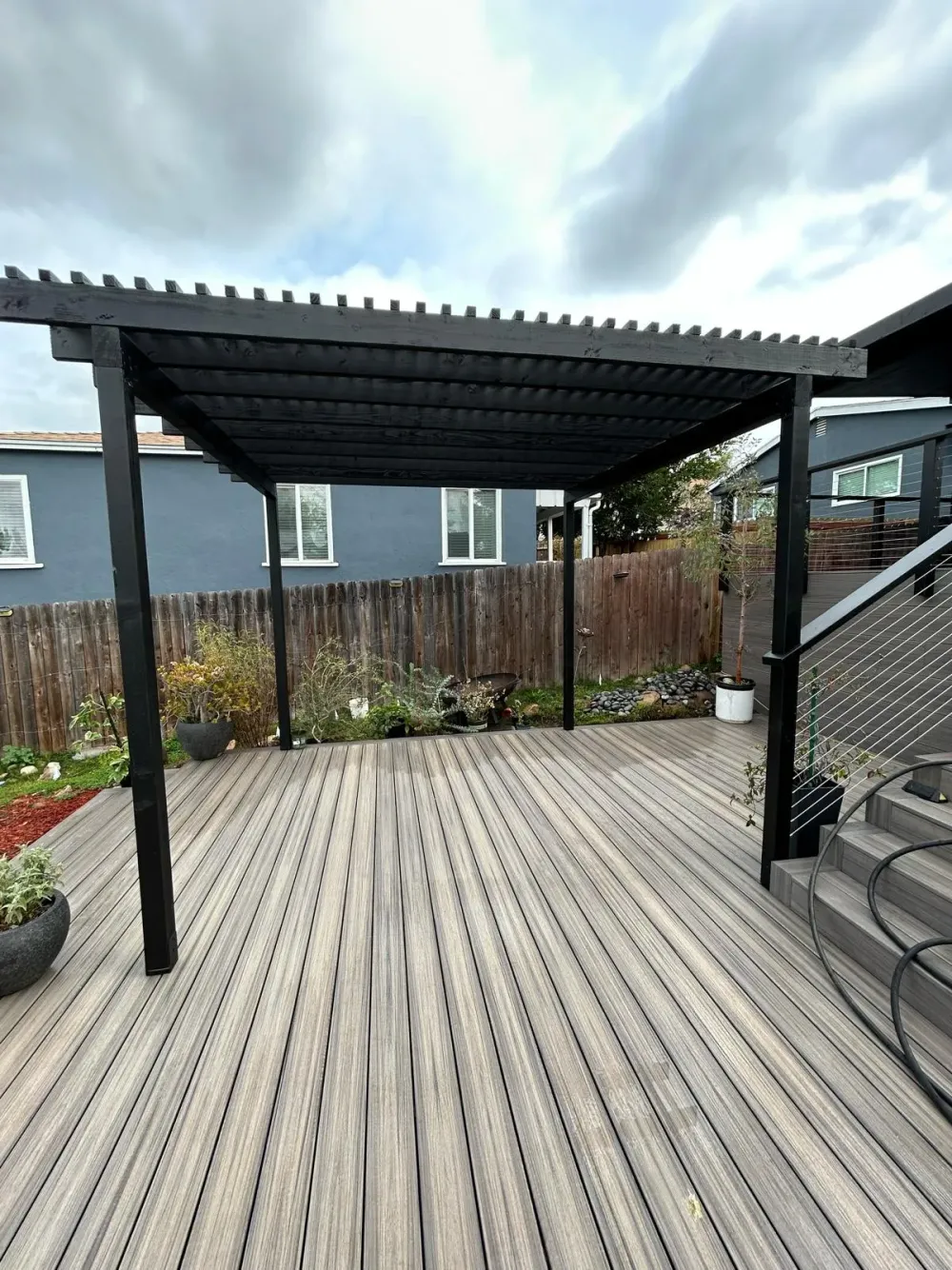
A patio cover is the difference between an outdoor space you use a few times a year and one you use most of it. The main decision is how much sky you want to keep.
The three types
Solid roofs
Full shade and genuine rain protection. A solid cover turns a patio into something closer to an outdoor room, usable in weather that would otherwise send everyone inside, and it lets you put furniture and electronics out there with some confidence.
The tradeoff is light. A solid roof against the house darkens the rooms behind it, sometimes dramatically. Before committing, look at what is on the other side of that wall — a kitchen or living room that relies on those windows can lose a lot. Where that is a concern, skylight panels in the roof recover much of it.
Lattice and open slat
The most common compromise, and the type shown above. An open framework of slats filters the sun and casts a striped pattern that moves across the day, which is a large part of the appeal.
How much shade you get depends on slat spacing and depth, and on which way the slats run relative to the sun's path. Deeper slats set closer together give more shade; a wider spacing gives a lighter, airier feel. It is not a rain cover — water passes straight through — but for sun management it is often the more pleasant choice.
Louvered systems
Adjustable slats that pivot from open to closed, so one structure gives you full sun, filtered light, or a closed roof depending on the day.
The flexibility is real and considerable. So is the complexity: more moving parts, more hardware, and a mechanism that has to keep working. If you want one structure to handle a wide range of conditions, it is the type that does it.
Let orientation decide
Which direction the patio faces should drive this decision more than appearance does.
- South-facing takes high overhead sun through the middle of the day. An overhead structure handles this well — the sun is above, so a roof or lattice blocks it directly.
- West-facing takes low, hard afternoon sun. An overhead cover alone does surprisingly little, because the light comes in sideways under it. These patios usually need something vertical on the sun side — a screen, a slatted panel, planting, or a drop shade.
- East-facing gets gentle morning sun and is often comfortable with a lighter structure.
- North-facing gets little direct sun and may want light retained rather than blocked, which points to an open framework.
The simplest way to get this right is to spend time on the patio at the hours you actually expect to use it, on more than one day, and notice where the sun is and where you wish shade was.
Attached or freestanding
An attached cover ties into the house, which makes the patio feel like an extension of the interior and provides a covered route out of the door. The connection to the house is the critical detail — that junction has to shed water away from the wall rather than trap it against it.
A freestanding structure sits away from the house on its own posts. It leaves the wall and its windows untouched, and it can be positioned wherever the yard actually wants it rather than where the house dictates — over a seating area at the far end of the garden, for instance.
Materials
Wood framing is warm, takes stain or paint, and suits most houses. It moves with the weather and benefits from refinishing over time, with sun exposure setting how often.
Aluminium does not rot and holds its dimensions, and powder-coated finishes wear well. It can be made in slimmer profiles than wood for the same span, which matters if you want the structure visually light.
Whichever you choose, the fasteners and connectors deserve attention — particularly near the coast, where salt air is hard on metal. That hardware is what holds the structure together and it is largely invisible once built.
Build it in now
A patio cover is a ceiling, which makes it the natural place for everything an outdoor room needs. All of it is far simpler to run during construction:
- Lighting — recessed, string light anchor points, or fixtures on the beams
- A ceiling fan, which needs proper blocking and a rated box
- Power for a television, heaters, or speakers
- Heater mounting points, with the structure sized to carry them
- Anchors for drop shades or screens on the low-sun side
The question worth asking first: do you want rain protection, or only sun control? That single answer eliminates roughly two thirds of the options and makes everything after it easier.