
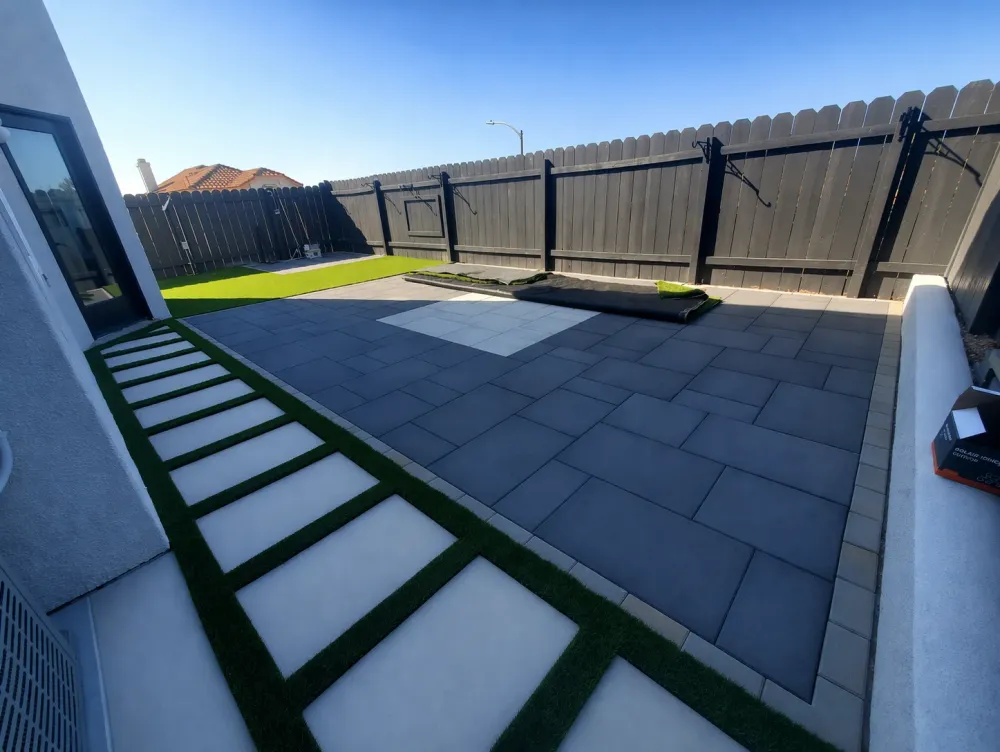
Pavers and artificial turf have become the default pairing for San Diego backyards, and combining them well is mostly a matter of geometry — plus a base nobody ever sees.
Why the combination works
Used alone, each material has a weakness. A large paved area can read as hard and unrelieved. A large field of artificial turf can read as flat and uniform, because it lacks the variation real planting provides.
Together they solve each other. Turf breaks up the paving with soft green lines; paving gives the turf structure and edges. The result is a yard that stays green year-round and takes very little water, without looking like a car park or a putting green.
Turf ribbons and inlays
The detail doing the most work in the photograph above is the turf running between the pavers.
Rather than a paved area beside a turf area, the two interlock: wide turf joints between large pavers create a ladder that leads the eye along the path. It softens what would otherwise be a solid run of stone and turns simple circulation into a designed element.
Points worth getting right:
- Keep the ribbons consistent. Even spacing is what makes it read as deliberate. Irregular gaps look like a mistake.
- Make them wide enough. Very narrow turf strips are hard to install cleanly and awkward to keep looking sharp.
- Set the pavers flush. The path should be comfortable to walk without watching your feet, so the turf should sit level with the paver surface rather than below it.
- Mind the edges. Every turf ribbon has two long edges that must be secured, or they lift over time.
Pattern and scale
Large-format pavers in a modular or running pattern, as shown here, read contemporary and calm — fewer joints means a quieter surface, and large units make a small yard feel larger.
Smaller units and busier patterns such as herringbone read more traditional and are visually more active. Herringbone also interlocks strongly, which is why it is common in driveways.
Two devices worth knowing:
A contrasting inset. In the photograph, a lighter panel sits within the charcoal field. A change of colour or orientation within a large paved area anchors a spot — under a table, at an entry — without building anything.
A border course. Running a soldier course around the perimeter frames the field the way trim frames a room. It also resolves the cuts neatly at the edges, which is where sloppy work usually shows.
The base is the whole job
Everything above is appearance. Whether it still looks that way in five years is decided by what goes underneath.
A paver installation is a system: excavation to the right depth, a compacted aggregate base, a bedding layer, the pavers themselves, then jointing sand, with an edge restraint holding the whole field in place. Pavers that sink, rock underfoot, or drift apart are almost always reporting a base problem rather than a paver problem.
Edge restraint matters especially. Without something holding the perimeter, the outer courses migrate outward over time and the joints open up. It is invisible and it is what keeps the field tight.
Drainage
Paving changes where water goes. A surface that previously absorbed rain now sheds it, and that water has to have somewhere to travel.
The surface should fall away from the house — always — at a slope gentle enough to be imperceptible underfoot but enough to move water. Where a paved area sits against a wall or fence that blocks runoff, a drain becomes part of the design rather than an afterthought.
Artificial turf drains too, through a perforated backing into the base beneath it, so that base has to be built to let water through rather than hold it.
Choosing turf
Quality varies enormously, and the differences are visible:
- Blade shape and height. Varied blade shapes and mixed heights look far more natural than uniform ones.
- Colour mix. Real grass is not one green. Products blending several greens with a little tan thatch read convincingly; a single flat green does not.
- Density. Denser turf feels better and stands up longer under traffic.
- Heat. Artificial turf gets considerably hotter than grass in direct sun. Worth considering where children and dogs will be, and a reason to keep some shade over it.
- Infill. What is brushed between the blades keeps them upright and affects both feel and drainage.
What upkeep actually looks like
Low-maintenance is not no-maintenance. Turf wants occasional rinsing and periodic brushing to keep the blades standing, particularly in traffic paths. Pavers want sweeping, and joint sand needs topping up over the years. Both benefit from clearing leaf litter before it breaks down in the joints.
Set against mowing, watering and feeding a lawn through a dry San Diego summer, it is a substantially lighter commitment — but it is not zero.
Worth deciding early: where people walk, where they sit, and where anything is likely to go later — a spa, a kitchen, a fire feature. Running conduit and stubbing utilities before the base goes down is straightforward. Cutting into finished paving afterward is not.